


Think of a very smart medical researcher. She has a great idea for an AI that can find a rare heart defect in children. The only problem is that she only has data from 50 patients. If you use more, you will break privacy laws and lose the trust of your patients. Her project, like so many others, runs into a wall. We're in a gold rush for AI, but we can't get into the mine. What if we could just make the data we need?
This is not a story from science fiction. This exact problem is being solved by a quiet revolution using AI tools. They are making fake data that looks like real-world data in terms of its statistical patterns. This makes everything different.
The Invisible Wall: Why Real Data Doesn't Work
It's not only about privacy. Of course, rules like HIPAA and GDPR make things very hard. But the problem is worse than that.
Think about how to teach an AI to find a new, complicated financial scam. You might only have a few real-life examples. You're using a garden hose to put out a forest fire. Also, data that is already out there is often biased. It shows how unfair things were in the past. Gartner made a shocking prediction: they think that by 2025, synthetic data will completely replace real data in AI models. This isn't a trend. It's a big change.
We have three problems to deal with:
- Privacy: Strict rules around the world keep personal information safe.
- Scarcity: It's hard to find rare events because they happen so rarely.
- Bias: AI that is based on bad data is also bad and often unfair.
The old way doesn't work anymore.
How can AI make data?
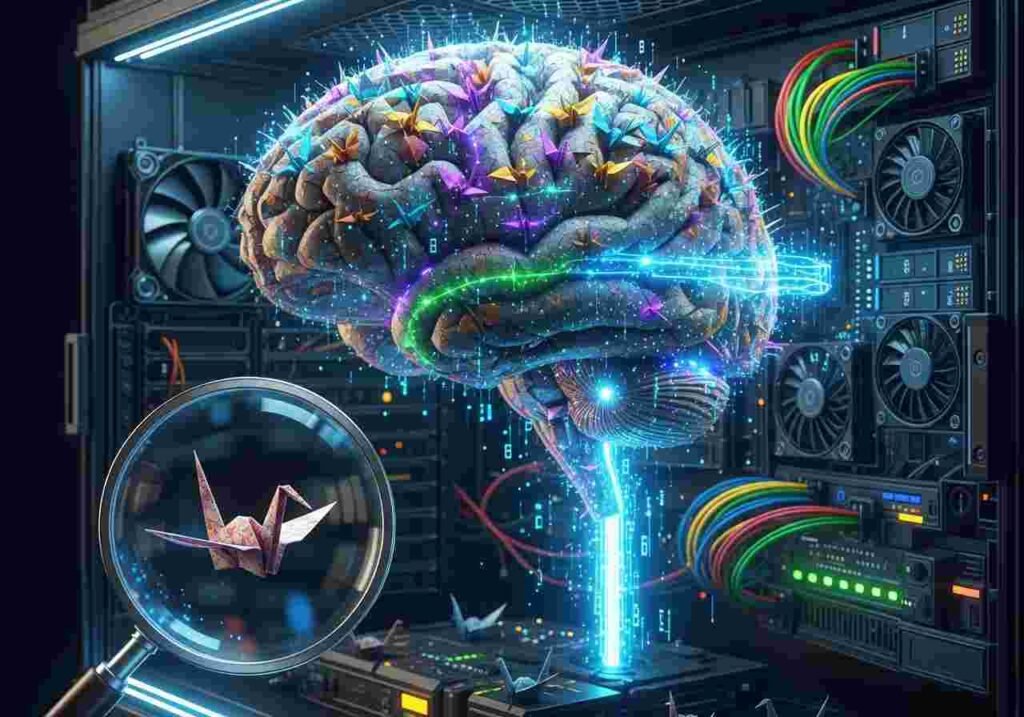
"AI dreaming" is the process that makes the magic happen. It's like a master artist learning how to make things look good.
Tools like Generative Adversarial Networks (GANs) are very important. The Generator is a part of the AI that makes fake data. The Discriminator, on the other hand, tries to find the fakes. They fight. The forger gets better and better over millions of rounds. What happened? A digital dataset that is statistically the same as the original but doesn't have any real people in it. It's a data doppelgänger that works great for training but not so great for revealing secrets.
Case Study: The Hospital That Never Handled a Patient File
NVIDIA worked with a big U.S. hospital network to help with a rare neurological condition. They only had 100 MRI scans in their real dataset. It was statistically useless for training strong AI.
They used an AI tool to look at those 100 scans. The AI learned how to tell the difference between healthy and sick brain tissue. After that, it started to work. It made more than 100,000 fake MRI scans. The fake scans had the same small signs of the disease.
The outcome was groundbreaking. In clinical trials, a diagnostic AI model that was only trained on this synthetic data got 99% of the answers right. They made a tool that saves lives without ever putting any patient's privacy at risk. This technology has that kind of power.
Case Study: The Bank That Made Up Fraud
The issue is distinct in finance. How do you teach an AI to find a fraud pattern that is just starting to show up? You don't have many real-life examples.
A European bank had to deal with this, and they worked with Mostly AI, a company that makes fake data. They had to come up with new, complicated ways to commit fraud without waiting for customers to be robbed.
Their AI tools made millions of fake financial transactions. These fake purchases looked like regular spending, but they also had the fraudster's fingerprints on them. This fake world trained the fraud detection AI to be a super-sleuth. It learned how to find the new crime pattern in the real world and stop attacks before they happened. Customers still trusted the company because their real data was never used to train the AI.
The Expert's Lens: A Different Kind of Duty
I talked to a data ethicist from a big tech group. She gave a very important warning that changed the whole conversation.
She said, "The risk doesn't go away; it just changes shape." "Now we're dealing with model fidelity instead of data privacy." Your AI won't just copy a hidden bias if you use it to make data. It will make it into an industry, making millions of perfect, flawed copies.
This is what leaders need to do now. You can't just trust the fake data. You need to check the AI tool that made it. Everything is governance.
What's next? The Synthetic Future is Multimodal
The future is now. It's going beyond medical scans and spreadsheets.
Companies that make self-driving cars buy a lot of things. They use synthetic data tools to make endless variations of rare, dangerous situations, like a child running after a ball into the street at dusk or a black car skidding on black ice. They can teach their AI how to handle a million crashes without actually having one.
Another area of research is robotics. Digital twins are being used by factories to train robot arms in very realistic simulated settings. These arms learn how to do difficult jobs in a fake warehouse for days before being sent to the real one. The savings and safety improvements are huge.
The Bottom Line: Stop scraping and start making
We are at a point of decision. The old saying "he who has the most data wins" is no longer true. The new winners will be the ones who know how to get the right data.
Synthetic data, powered by advanced AI tools, is the key that unlocks innovation in our privacy-conscious world. But we need to use this key wisely. The question is no longer, "Is it possible to get the data?" The most important question right now is, "Are we smart enough to make it responsibly?" Our answer will determine the future of AI.



One thought on “AI Tools Generate Privacy-Safe Synthetic Data”
[…] not easy to make a robotic bee. It's a combination of miniaturization and AI. Imagine them as flying robots that are very smart. Their eyes are tiny cameras. Their AI brains […]