


Suppose a factory robot does not just disintegrate. It heals. This is no longer a science fiction. The laboratories around the globe are breaking the riddle of self-repairing machines. This innovation would transform industrial Robotics. It combines intelligent substances and smart software. The result? Uncannily bio-resilient machines.
What should this imply to the future of automation? Let's explore.
The Science Behind the Healing cut
What is the way of making metal and plastic regenerate? There are two brilliant ways used by researchers. The first is that the intrinsic healing materials have little embedded capsules. Impact breaks these capsules, releasing a liquid monomer. This material quickly seals cracks. This material quickly seals cracks.
It's like a robotic scab.
The other technique draws inspiration of our skin. The scientists produce reversible bond polymers. A slight heat will cause the material to re-knit itself literally. The system can repeat the process multiple times. The aim would be to have a lasting repair.
It is not only creating machines but developing biomechanical hybrids. - Lena Petrova, the lead of Materials Science in the Aachen Institute of AI Robotics.
Such materials require a nervous system. That is where AI Robotics enters the picture. A strain and damage is continuously monitored by a network of micro-sensors. The problem is then diagnosed by the AI. Lastly, it stimulates the specific curing plan. This forms a self-awareness loop system.
Test and Case Studies in the Real World
A beautiful real-life example is given by the European SHERO project. Their robotic gripper is soft and can be punctured and repaired completely. The procedure lasts within forty minutes. This is essential in the transportation of delicate fruits or costly electronics. It averts expensive contamination and unavailability.
Take into account the monetary implication. One halt in the automotive assembly line will cost 20,000.00 in one minute. Now multiply that by the world manufacturing. The savings of time spent in a downtime can be estimated in billions of dollars a year. Self-healing isn't a luxury. It is an economic necessity of the contemporary factories.
The vision is to have a 10,000 hours working robot that does not need any maintenance service. - Project Manager, SHERO Consortium.
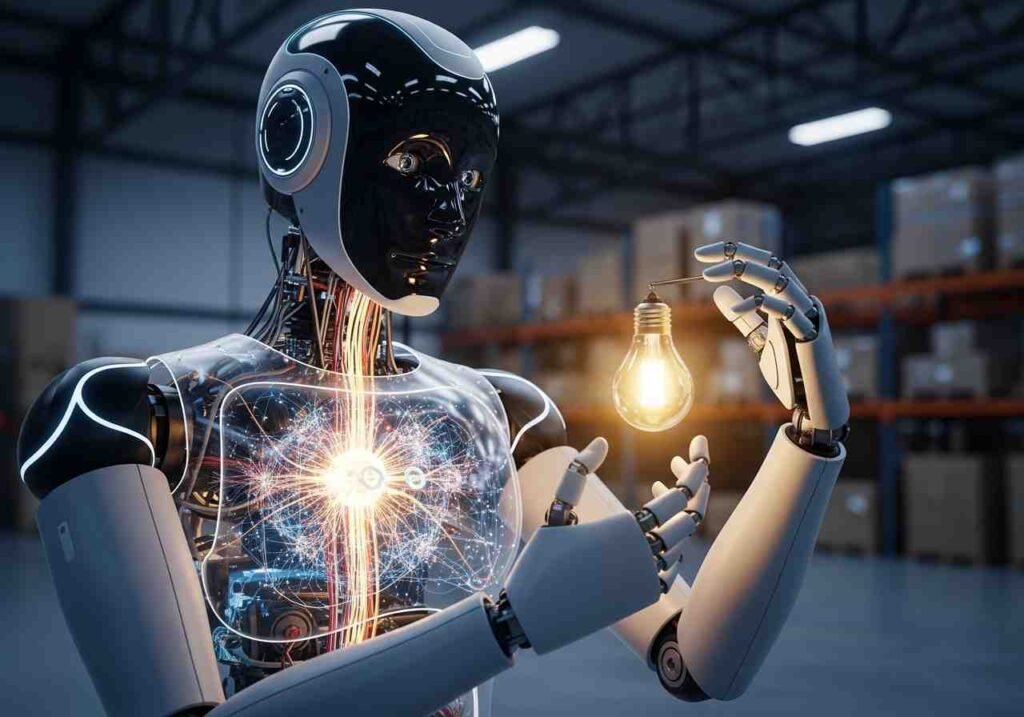
The applications are much farther than the factory floor. Here is a Humanoid Robot exploring a disaster area. One of its arms is gouged with a sharp piece of debris. Rather than fainting it closes the bruise. This is so that the mission does not end. It could save lives.
The Expert Opinion: The New Generation of Machine
Recently, I had an interview with one of the lead engineers of an automation company operating in Boston. He presented a constructionist view. He said it was decades of accomplishment to make robots faster and stronger. Now we are working on bringing them into life more. The new accuracy is resilience.
He claimed that real freedom does not only lie in decision making. It is also physical independence. An autonomous machine should be capable of taking care of its health. This becomes the second frontier of AI Robotics. It is a radical change in the philosophy of engineering.
This development is similar to biological adjustment. Animals in the wild live because they are able to recuperate. The same will be required in our machines. This is particularly in relation to sending them out into the brutal unpredictable environments. Through the deep-sea to the surface of Mars.
The Roadblocks to Unbreakable Machines
Naturally, large obstacles are present. The major exchange is usually power against the capacity to heal. Most of the self-healing polymers are not as hard as conventional materials. This restricts their application in heavy-load applications. Search of a strong and fast healing material is going on.
Moreover, the healing process is time consuming. Fabricating a 40 minutes fix is excellent in the case of a premeditated failure. Yet it is too long to be a critical process. Scientists are on a race to hasten these chemical and mechanical reactions. The other great challenge is speed.
Another important factor is cost. These high technologies and sensor systems are costly. Mass adoption needs the price to reduce drastically. But like any technology, there will come the time that economies of scale will take effect. Making it accessible.
Your Future with self-healing Robots
So, what does this mean for you? In the short-term, a greater number of reliable products and reduction in supply chain disruptions. It allows us to create technologies that we can hardly imagine in the long run. Imagine the Humanoid Robot house help that spends decades in your house.
It is no more a discussion on whether this will occur. It is concerning the way in which we will handle it. What will we do to make maintenance schedules of self maintaining machines? What are the new safety standards we are going to require?
This technology does not only avoid failures but also creates confidence between the machines and people. - Tech Ethicist, MIT.
My strong opinion? The new asset class is being born. In the near future we will classify robots not according to their activity, but according to their life duration. The change of disposable machinery to long term partners is unavoidable. This is the actual potential of self-Repairing Robots. It is the key to an automated sustainable future.